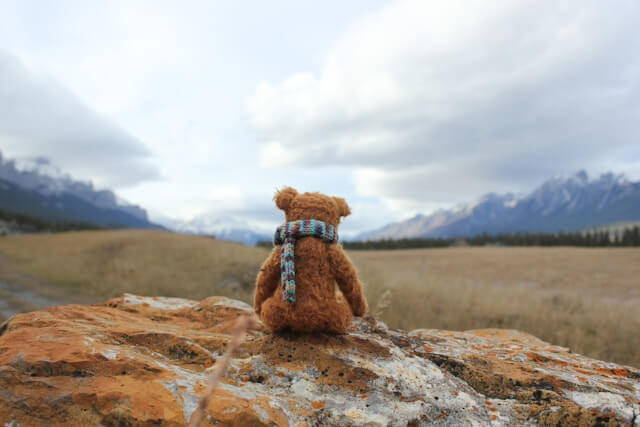
In 2010, I wrote a blog post called “Teddy Bear Country,” in which I attempted to answer my young daughter’s question: “Why are bears like babies?” She meant, why are bears so often portrayed in an infantile fashion, as in modern versions of “The Three Bears,” and the ubiquitous teddy bear?
As soon as she asked, I became obsessed with the notion.

Ferocious Bears and a Gentleman President
Eleven thousand years ago, the North American short face bear became extinct, along with the rest of the continent’s megafauna. It was a deadly predator, perhaps one of the deadliest mammals ever, and some people believe its existence may have delayed the dominance of humans in North America by several hundred years.
Yet, 11,000 years later, the short face bear’s local kin—grizzlies, black bears and polar bears—though as wild as ever, are often mistaken for someone who wants a cuddle.
Why?
There are a number of theories floating about, including one by Jon Mooallem in his March 2014 TED Talk “How the Teddy Bear Taught Us Compassion.” He tells the story of President Theodore Roosevelt, an avid big game hunter, who spared the life of an injured and frightened black bear that had been tied up for his “sporting” pleasure.
The President’s famous refusal, at the dawn of the environmental era and the growing awareness of dwindling wildlife in their dissolving habitats, sparked something in the American psyche. So, when Morris Michtom issued a stuffed creature he named “Teddy’s Bear” just in time for Christmas, the public pounced. We went, claims Mooallem, from seeing bears as rage-filled killing machines to the underdog—creatures dependent on our good will for their survival.
The Fairy Tale Connection
The infantilization of bears and other wildlife has influenced modern re-tellings of fairy tales. Specifically, our recent understanding of “Beauty and the Beast” not only mirrors our changing relationship to nature through the past few hundred years, but encapsulates these changes all in one telling.
To the earliest audiences of fairy tale’s ancestors, the medieval romances, the bear figures as the totem of the wild man, the dweller in the untamed forest, all natural appetite and ferocity.
Warner, Marina. From the Beast to the Blonde: On Fairy Tales and their Tellers (London: Random House, 1995), 300.
The beast in Disney’s Beauty and the Beast shares characteristics of bear: the ability to stand on four legs or two, the capacity for enormous rage and sublime tenderness, omnivorousness, powerful paws, fur, a snout, and forward seeing eyes. For all intents and purposes, Beauty’s beast is a bear.
Bear has gone from feared forest dweller and messenger of the gods, to captive fool, to healing companion and object of tenderness. From terrorizing scattered groups of near-naked humans bent on survival to object of mockery:
So, by the seventeenth century, the [bear] had fallen far below his early medieval stature as King of the Beasts. And it shared something else with donkeys: from the point of view of the humans, it was an intermediate beast, not exactly docile, but nevertheless biddable; a performing bear was neither a wild beast nor a domestic pet; it could be made to serve its owner’s wishes—up to a point.
Warner, Marina. From the Beast to the Blonde: On Fairy Tales and their Tellers (London: Random House, 1995), 302.

Teddy bear distorts Bear’s true nature by nurturing in us a vision: that we are kin—not in the sense of reverence or totemism, but in the sense that it’s up to us to protect it. We want to save bears, other animals, the wild world. We want to save ourselves. But we are not always cuddly beings either, and in order to unleash our compassionate natures we resort to projecting infantile qualities onto the beast. Bear’s rage makes us afraid; its enslavement is laughable (bears are still used for entertainment); its infantilization makes us care about its plight.
In the earliest literary version of the fairy tale “Beauty and the Beast,” “The Beast is a truly fierce figure, not a gentle soul disguised by fur.” (Windling, Terri. “Beauty and the Beast, Old and New.” Journal of Mythic Arts, accessed January 11, 2016). The story reflects the fears of French writer Madame Gabrielle–Suzanne de Villeneuve in 1740 (and the women of her time and place), who could be forced into marriage with a stranger, and find themselves in bed with something too awful to endure.
A few years later, a French governess working in England published a shortened version of de Villeneuve’s story that became wildly popular. In this version:
The emphasis shifts from the Beast’s need for transformation to the need of the heroine to change — she must learn to see beyond appearance and recognize the good man in the Beast. With this shift, we see the story altered from one of critique and rebellion to one of moral edification, aimed at younger and younger readers, as fairy tales slowly moved from adult salons to children’s nurseries. By the 19th century, the Beast’s monstrous shape is only a kind of costume that he wears — he poses no genuine danger or sexual threat to Beauty in these children’s stories.
Windling, Terri. “Beauty and the Beast, Old and New.” Journal of Mythic Arts, accessed January 11, 2016
In Conclusion
Disney’s Beauty and the Beast completes the bear triptych of beast-fool-companion. Once the Beast’s rage is subdued, he undergoes a series of misadventures as Belle attempts to domesticate him. He often looks like a fool. And he is enslaved by his need for her to save him from the enchantment, from himself.
“He was dear, and so unsure…” Belle sings, as the Beast wins her heart, and ours. It is a “tale as old as time.” From wild to tame, the game requires collusion, the mastery of self and others.
We have stripped bear/beast of ferociousness, skinned it, and wear its skin as a costume. We see ourselves in it and it in ourselves. Perhaps we are trying to save both.