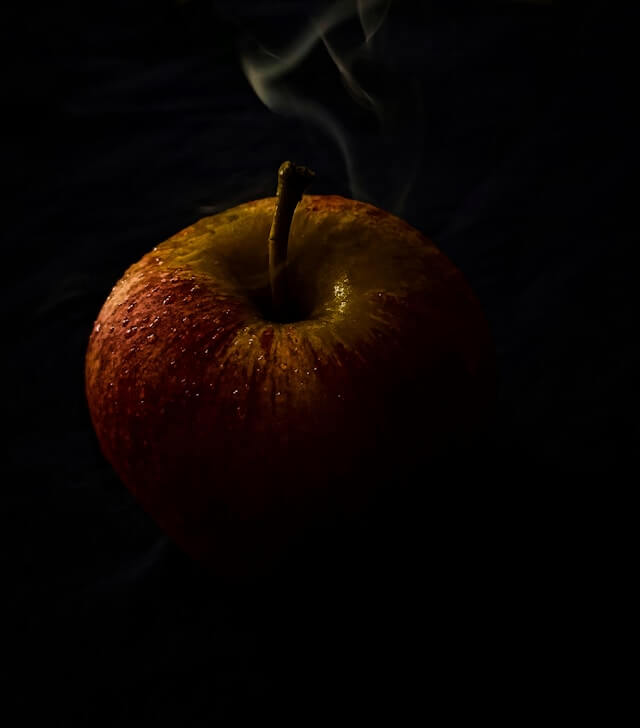
The apple has been the fruit family scapegoat ever since Eve plucked one from the tree of knowledge and was thrown out of Paradise. As with many scapegoats, the apple is more than the sum of its alleged misdemeanours. The fact is: Eve likely never saw an apple. And we’ll never know for sure which juicy tidbit caught her eye.
Etymology

In Middle English, the word apple was used to denote fruit in the general sense, including nuts, excepting berries. Pomme de terre is French for potato–literally, earth apple. Pomum is Latin for apple and fruit. Pomona was the Roman goddess of fruit. There is ample evidence that apple has long been a generic word for fruit.
All that being said, apple is also a word used to denote a specific fruit whose significance to British, Celtic, and European peoples cannot be overstated.
The case in point form:
- The wild apple is native to Europe and Western Asia
- The crab apple is indigenous to Britain
- The Greeks and Romans planted apple orchards
- Apples maintained the immortality of the Norse gods
- Apple bark and the soil of apple orchards were used to promote fertility
- Apples have ensured health and healing, perhaps for as long as 5,000 years
Apples play as prominent a role in stories as they do in life.
Fairy Tales
Snow White accepted the fateful third gift from the evil Queen, after rejecting the laced bodice and the poisoned comb. Is it because, much like Eve, Snow White couldn’t resist the apple? The truth is that in the earliest versions of this particular tale there was no poisoned apple. The Grimm brothers deliberately scapegoated the fruit. But why?
Early variants of “Snow White” tell us a different story:
- In “The Young Slave” (Giambattista Basile, 1634), the child Lisa is put to sleep by an enchanted comb
- In “Maria, the Wicked Stepmother, and the Seven Robbers” (Italy), the girl Maria is undone by an enchanted ring
- In “The Crystal Casket” (Italy), Ermellina falls asleep after tasting poisoned sweetmeats, and then again after being fitted with a too-tight garment
Jacob and Wilhelm Grimm published their first edition of fairy tales, Kinder-und Hausmarchen, in 1812. From the start they worked to smooth the rough edges of the tales, appropriating them for the gentle reader of the day whose Christian values were paramount.
Later Grimm editions of the tales, including even later translations by others, continued to make them more palatable. The Grimms introduced the poisoned apple to “Snow White.” Their earliest version has the Queen offer the ebony-haired girl the poisoned half of an apple, while she eats the healthy half in order to reassure the hesitant Snow White.
Interestingly, by cutting the apple in half the Queen reveals the five-pointed star at the seed centre (a pentagram), the same characteristic of the fruit that made it significant to Druidic and other pagan ceremonies. Of course, this also made it repugnant to Christian religious officials of the Middle Ages and later.

Snow White descends into a death-like sleep. By eating the fruit she consumes the Queen’s toxic essence, paralleling earlier versions of the story that have the Queen eating what she believes is the girl’s pure heart.
The Grimms were Christian men and tried not to offend. Scapegoating the apple is the noble tradition to which they succumbed.