Wolf is the devil. Wolf is the mother. Wolf is a threat to the sheep in the fold. Wolf is spirit guide, sometimes brother.

Wolf represents the best and the worst of humanity. This could explain the prevalence of wolves not only in deep-time myths and legends but in the fairy tales that have maintained their staying power. A word of caution is necessary, however, for fairy tales have been continuously remade in the image of the values held by those with a public voice. When yarns were spun, as opposed to written down for mass consumption, they were told by old wives, and the old wives’ tales were not lies; they often revealed the vulgar, earthy energy of female heroines, long before they were cast as victims.
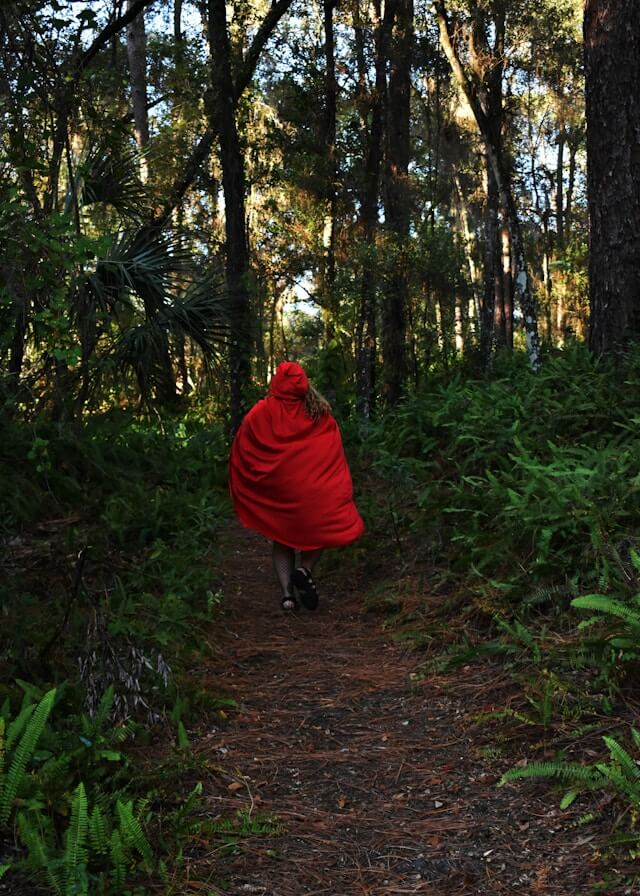
“Little Red Riding Hood” is one of the most popular fairy tales of all time. It speaks to Red’s passivity: the mother dresses the girl in a red cape; she is ordered to take food to her grandmother and to speak to no one along the way. The girl is unprepared to take the path in the woods alone but must do so anyway. We are hardly surprised that she is preyed upon by a wolf and must be saved by a handy woodcutter. The penalty for disobeying authority is harsh.
There is a more ancient version of “Little Red Riding Hood,” one that is a hearty soup of thrills, horror and adventure, in comparison.
In “The Grandmother’s Story,” the girl, to be sure, sets out to take nourishment to her ailing grandmother. But she embarks on a real journey, one where she must make decisions and take action. When the wolf appears, he offers the girl a choice: take the path of needles or the path of pins.
As Terri Windling points out in her excellent essay “Little Red Riding Hood: The Path of Needles or the Path of Pins,” this choice is not meant to be arbitrary nor amusing; it is a choice between continued maidenhood (pins) or growth toward womanhood (needles). (Signifying the essential connection of women’s work to women’s bodies, minds, and spirits).

“The Grandmother’s Story” includes a step-by-step undressing as the wolf goads the girl into stripping off her clothes. When, at last, she is completely naked, the girl understands that her life is in danger, and she tells the wolf that she must go outside to excrete her waste. The wolf ties a rope around her ankle so that she can’t escape, but the clever girl removes the rope from her leg and ties it around a tree. She runs away with the wolf in pursuit some distance behind. On reaching a river where some old women are washing clothes, the girl crosses over on a makeshift bridge of material held by the women. In the same fashion, the women allow the wolf to reach the middle of the river before dropping it into the water, where it drowns.
The wolf dies as it does in “Little Red Riding Hood.” But in this tale, the girl isn’t merely saved. She is reborn, having crossed the river into maturity. And the old women are the threshold keepers in the way that women have been since the dawn of time, as birth and death doulas, healers, counselors, priestesses, and much more.
As dog is a domesticated version of wolf, so is “Little Red Riding Hood” a domesticated edition of “The Grandmother’s Story.”
Choose your path. Choose it wisely. Traverse it well. Listen to the grandmothers.